
Sister, are you Feeling Fat?
You may need to dissolve your Compounding Energetic Loops


At the cost of giving my own age away, I’ll share the following. I remember well my own impossible - painful - desire to be shaped like Kate Moss. She had straight up and down waist and hips. She had a big inner thigh gap. She was boyish, waif-like, delicate. A bit sickly looking. High cheek-bones. Tiny. I was living in London at the time, and this was the LOOK. I, meanwhile, was curvy, and robust. Vigorously healthy, and glowing, like a milkmaid.
I realise now that all this was a good thing. But, back then, I hated my fullsome body with painful intensity. Concave bellies were presented everywhere as the ideal. But all bellies, no matter how slim the person they are attached to, will protrude after a meal. Looking back, I spent far too many years obsessed with being as thin as possible. I was often successful, but there was always a cost. That cost was continuous hunger, obsession, and deprivation. Non-stop vigilance. I actually said no to ice-cream for many years! (That blows my mind now. Never, ever say no to ice-cream!… I’m joking. Kind of.)
I have since discovered that ‘feeling fat’ is a frequency. You can feel fat and not - objectively - be fat at all. Or you might feel fat and actually be fat. Either way, the feeling fat frequency (FFF) is the key here, not your BMI. I felt fat for many years when I wasn’t. I also felt fat when I was fat. I also felt fat when I was underweight. Notice the pattern?
The feeling fatness was like a little dog nipping at my heels, forever giving chase. Perhaps, nowadays, I am a little fatter than I once was. But I don’t feel fat. I feel great. All the bulges and curves and soft bits feel voluptuous to me. I do not wish for bits of my body to be sucked out with a vacuum cleaner. Or cut off with a scalpel.
And this is the key, I think, to this whole game. It’s all about transmuting the Feeling Fat Frequency. It’s not really about the physical fatness or thinness at all. That will take care of itself once you clear your field of FFF. Being overweight is an effect, not the cause, of FFF.
So, to state it again in another way:
Being overweight is a reflection of the compounding energetic loops of Feeling Fat Frequency.
Some historical context

Our current obsession with extreme female thinness is a recent and narrow moment in history. We all know that Rubens, in the 1600s, painted soft, generously built women. They were considered the height of beauty. To be Rubenesque was, for centuries, a compliment.
The Renaissance broadly favored a fuller figure. Fatness was welcomed. It was considered a sign of prosperity and health. A well-fed body meant a family that could afford food. Most people couldn’t take abundant food for granted. Thinness signaled poverty, illness, or hardship. It didn’t signal discipline.
Victorian standards evolved, somewhat. However, a fuller bust and hip was still prized, although now with a corseted waist. The hourglass figure was esteemed. Even into the mid-twentieth century, the ideal was usually plumper than our contemporary standards.
It was always there, but the ultra-thin ideal didn’t dominate until the later twentieth century. It tightened further with the “heroin chic” aesthetic of the 1990s. This was the Kate Moss look explicitly named for its resemblance to the wasting of addiction and illness. We inherited a beauty standard named after a disease state. And, with it, the adulation of nihilism.
Female body ideals come and go. But, while you are culturally immersed, it is very hard - almost impossible - to see beyond them.
There was a commercial when I was a child all about ‘pinching an inch’. If you could pinch more than inch, you were fat, and you needed to eat their low-fat yoghurt. Or whatever they were touting. Perhaps it was Special-K (cereal without the fun). But, of course, everyone can pinch an inch somewhere on their body, no matter how skinny they are. Skin, itself, is more than an inch thick in many places. I think that commercial alone created a generation of anorexics. Or, the flipside, it caused overweightness. Because, in so many ways, overweightness is a natural response to the threat of starvation.
And, before we go further, let me be clear. I’m not saying that we all just accept being overweight. Not at all. I’m proposing that we first heal the ‘feeling fat frequency’ and the rest will take care of itself. That we can liberate ourselves from the straitjacket right now, no matter what our body is doing. But I’ll circle back to this. First, let’s get some more context.
Religion, Self-Flagellation, and the Puritanical Worship of Female Skinniness

The equation of thinness with virtue didn’t begin with fashion magazines or low-fat yoghurt. It has deep roots in religious history.
Early Christian ascetic traditions taught that the flesh was an obstacle to holiness. Mystics fasted for extended periods. They believed hunger brought them closer to God and further away from sin. Some medieval Christian mystics - many of them women - practiced what historians now call “holy anorexia.” This was extreme fasting as a devotional act. Starving the body was purifying the soul. Several of these female mystics were later canonized. Their emaciation was held up as proof of sanctity.
Self-flagellation movements, particularly in the fourteenth century, took this further still. They treated the deliberate wounding of the body as a path to redemption. The body was the enemy. Appetite of any kind was morally wrong. Denial was holy and indulgence was sin.
This theology filtered out into wider Western culture. It attached itself with particular force to women. A woman who denied her own hunger was considered pious, controlled, and morally superior. A woman with visible appetite, for food or anything else, was seen as unruly, sensual, dangerous. The corseted, restricted Victorian woman inherited this lineage. So did the diet culture that followed after her.
Ultra-thinness may have only become the beauty standard in the twentieth century. However, the moral architecture was already centuries old. We simply started calling it discipline instead of holiness.
Starvation Culture

Celebrities offer a mirror for all of this. Their bodies get discussed by millions of strangers. Adele lost a significant amount of weight in 2020. Headlines called it a “transformation” and a win. Magazine covers treated it like an achievement to be congratulated. But Adele herself later said the conversation missed the point entirely. She had lost weight for herself, for her own reasons. The public turned it into a referendum on her worth.
It’s the same religious and moral posturing, playing out in a different form. Contraction, shame, brief relief, contraction again.
The same puritanical thread runs through high fashion. The very thin runway model was invented in the twentieth-century. Designers and fashion houses wanted attention on the clothes, not the body wearing them. A voluptuous figure, it was argued, drew the eye toward the model’s curves rather than the clothes. A thin, minimally-shaped body became a rail for clothing to hang from. Twiggy’s rise in the 1960s made this widespread. Her very name described the aesthetic.
Heterosexual men often get the blame for all this, as they do for a lot of things. But high fashion is mostly driven by the tastes of women and gay men. Most heterosexual men prefer women of healthy weight, not overly skinny. Many really love a bit of fatness in women. The idea that starvation culture has been created by men is yet another displacement of our feminine agency. No, ladies, we did this to ourselves. Or, at least, we accepted it for ourselves. That’s good news, because it means we can also undo it.
What began as an industry preference for silhouette became a moral standard. The ultra-thin body was once only a means for displaying clothes. But it was subconsciously infused with the older religious thinking. Thin meant disciplined. Disciplined meant good. The runway and the reliquary, centuries apart, ended up at the same place. Women either starved, or were shamed. Holiness or sinfulness, take your pick.
Fasting has, in recent years, become trendy. I was deeply into fasting, years before anyone else was doing it. And I am not denying fasting’s potential health and spiritual benefits. It has many. Yet it is also another iteration of the starvation culture. The same old pattern dressed in new language. The underlying impetus remains restriction and control. The belief that the body must be denied to improve. The equation of self-control with moral worth. The quest for holiness through starvation.
Fatness and Class
For most of human history, fat was a class marker. The peasant was thin because they were poor. The aristocrat was round and robust. Thinness meant scarcity. Fat meant prosperity. This held true across most of Europe for centuries. In many parts of the world it held true well into living memory, and may be true even now.
That equation flipped in the twentieth century because the supply of food advanced. Industrial agriculture made calories abundant for almost everyone. Being able to afford food was no longer rare, so it stopped being impressive. Instead, being able to control food intake was rare. Thinness became evidence of discipline, leisure, access to good information. It signaled having the money for a personal trainer or a nutritionist. It impled that you had the time not to be surviving on whatever food was cheapest and fastest. Meanwhile, those with the least money and time ate the cheapest, most processed foods. Fatness moved down the status ladder and thinness moved up.
That inversion has only sharpened with drugs like Ozempic. They are expensive, often not covered by insurance, and functionally out of reach for a lot of people. So we now have a new, very literal class divide sitting on top of the old cultural one. Those who can pay to be thin, and those who cannot. A lot of what gets called “willpower” or “discipline” is about money.
Sexuality and Food

Food and sexuality have always been intertwined. Appetite for food and appetite for sex arise from the same deep well. When appetite for one is suppressed, so, often, is the other. When we fear and control our hunger for food we simultaneously fear and control our desire for sex. The body banned from receiving nourishment cannot fully receive sensuality.
Historically, this connection was clear. Feasting and fertility rites recognized that a well-fed woman had powerful life force. Starvation culture severs that flow. It turns the body into something to be managed rather than enjoyed. When we allow an unashamed relationship with food, we may discover freer sexuality. As we release guilt and shame - as we transmute FFF - we allow ourselves both nourishment and pleasure.
Glorifying Unhealthy Fatness
None of this means being overweight or obese should be glorified. These can be equally - or perhaps more - unhealthy. The truth sits in the wide, forgiving middle. That is the place most bodies naturally settle into once FFF leaves the field. A healthy range is broader and kinder than the narrow strip often marketed to us.
There has been a necessary pushback against Starvation Culture. But now a different distortion has crept in. This is the acceptance of obesity, ignoring the risk to our health.
This isn’t liberation. It’s the same old trap. A culture that shames thinness into starvation. A culture that celebrates obesity regardless of the health dangers. Both avoid truly listening to, or respecting, the body. Both are a denial of sexuality, sensuality and female beauty.
Healthy weight has a range. That range is wide, but it isn’t infinite. Loving a body fully doesn’t mean every state of that body is equally healthy. It means being honest while refusing to attach shame. We can say, honestly, “this level of weight isn’t optimal for me,” without saying, “and therefore I’m a failure as a person.”
The Spiritual Dangers of Ozempic
So now we find ourselves in the era of Ozempic. Big Pharma is selling us yet another mechanistic solution. Another poison. And, like the sorcerer’s apprentice, we once again tinker with magic we don’t understand. The human body is a highly intelligent system. Appetite is one of the body’s oldest languages. If that language gets silenced without addressing the underlying FFF, nothing is ever resolved.
A silenced frequency tends to look for a new voice. The grief that once spoke through overeating may begin speaking another way. The costume changes. The frequency underneath doesn’t until it’s acknowledged and transmuted.
A shortcut that bypasses the body’s own signals can leave hollowness in its wake. Many people using these medications describe exactly this. A loss of appetite for food that seems to arrive alongside a loss of appetite for life. Appetite, on all levels, is a signal of good health.
The Mother Wound

A disharmonious relationship with food may stem from our relationship to our mother. Healing the mother wound can heal the food wound, and the reverse is also true. This is not about blaming our mothers. They are blamed for enough. It’s simply about healing what needs to be healed.
Our earliest experience of being fed is also one of our earliest experiences of being loved. The infant learns whether the world is safe at the breast or the bottle. A mother might be anxious, absent, or inconsistent during those first feedings. Our nervous systems may forever after associate food with vigilance. We reach for food later in life to recreate, or resolve, that original frequency.
Demeter is the goddess of grain and harvest. She is the archetypal grieving mother. When her daughter Persephone is taken from her, Demeter withholds the harvest. The earth starves because the mother’s grief has not been resolved.
Compounding Energetic Loops

Everything we’ve discussed so far is one energetic loop, wearing many costumes across centuries.
A loop compounds when it isn’t interrupted. It strengthens instead of resolving. The infant’s early feeding wound finds a religious framework centuries later. That framework doesn’t disappear either. It waits until fashion offers a new, secular vocabulary for the same old judgments. Those judgements don’t disappear. They wait until a pharmaceutical arrives offering to silence the whole conversation.
Each generation inherits the accumulated weight. This makes the energetic pattern heavier than any single cause could explain. It isn’t only our own mother wound, or our own relationship with food, or our own century’s beauty standards. It is all of it, compounding. FFF is one dense frequency stacking on top of another. And our bodies are still asking, underneath it all, for the same simple thing. To be seen. To be fed with love instead of judgment. To be trusted to know its own hunger.
This is why the work can’t be done at only one layer. Fixing the plate on the table without touching the mother wound leaves the loop intact. Healing the mother wound without addressing ancestral shame isn’t enough. The layers must be recognized together as one compounding structure.
The body is an effect, not a cause. It cannot heal or sicken independently of consciousness. It’s a set of perceptions we are currently experiencing. An aspect of consciousness, a projection of the mind. We don’t have a body, and we aren’t in a body. The body is inside us.
The body is also morally neutral. It isn’t good or bad, fat or failing. It’s only what we tell it to be, or believe it to be.
The body’s language is frequency. It listens and responds to:
Thoughts
Words
Actions
Emotions
Beliefs
Every one of these is an instruction. Excess weight is the body following instructions we gave it. FFF is an instruction.
There is no real boundary between the body and the field around it. What looks like a separate, solid thing ending at the skin is only a denser set of perceptions. This is all one continuous field. The body is not cut off from thought, emotion, or the wider field of being.
Grief that never finished grieving. Fear that never got to move. An old contract of protection made in a moment mostly forgotten. All of these are frequencies. The body is frequency too and reflects them back.
But, if the body is an effect, it can change as the instructions change.
What Overweightness May Be Reflecting
The need for grounding
An attempt to anchor deeper into embodiment or leave embodiment
A denial of emotion, including anger
A desire for protection from sexuality, our own or someone else’s
It may be about making ourselves bigger or less noticed
An over-reliance on the pleasure of food
A trauma response to the threat of starvation (over-dieting. Low-fat yoghurt. Special-K.)
Exhaustion
A death wish
A mother wound
A continuous tuning into Feeling Fat Frequency
Grounding

FFF may be a symptom of trying to leave, transcend, or dissociate from the body. It may be a symptom of denial of the body’s existence. We aren’t here to escape the body. We’re here to become more fully present in it. To bring more of the Higher Self here, into this embodied life. We need to fully enjoy the sensory experience. We need to ground. When we ground, we strengthen our field and transmute more of the FFF.
Here are some ways to ground and become more sensual:
A daily walk in nature
Real, delicious, homemade food
Rest
Movement
Music
Time with animals and children
Conscious breathing
Massage
Wholesome touch
Gardening
Self-care such as applying lotions or taking fragrant baths
Luxuriate in beautiful textures and fragrances
Loving touch
Paying attention to the colors, textures, sounds and scents around us
Being present with food. As we eat, we can draw energy from it and let it heal us on other levels too.
These aren’t lesser physical concerns beneath the spiritual work. They are the spiritual work itself.
Choosing Food
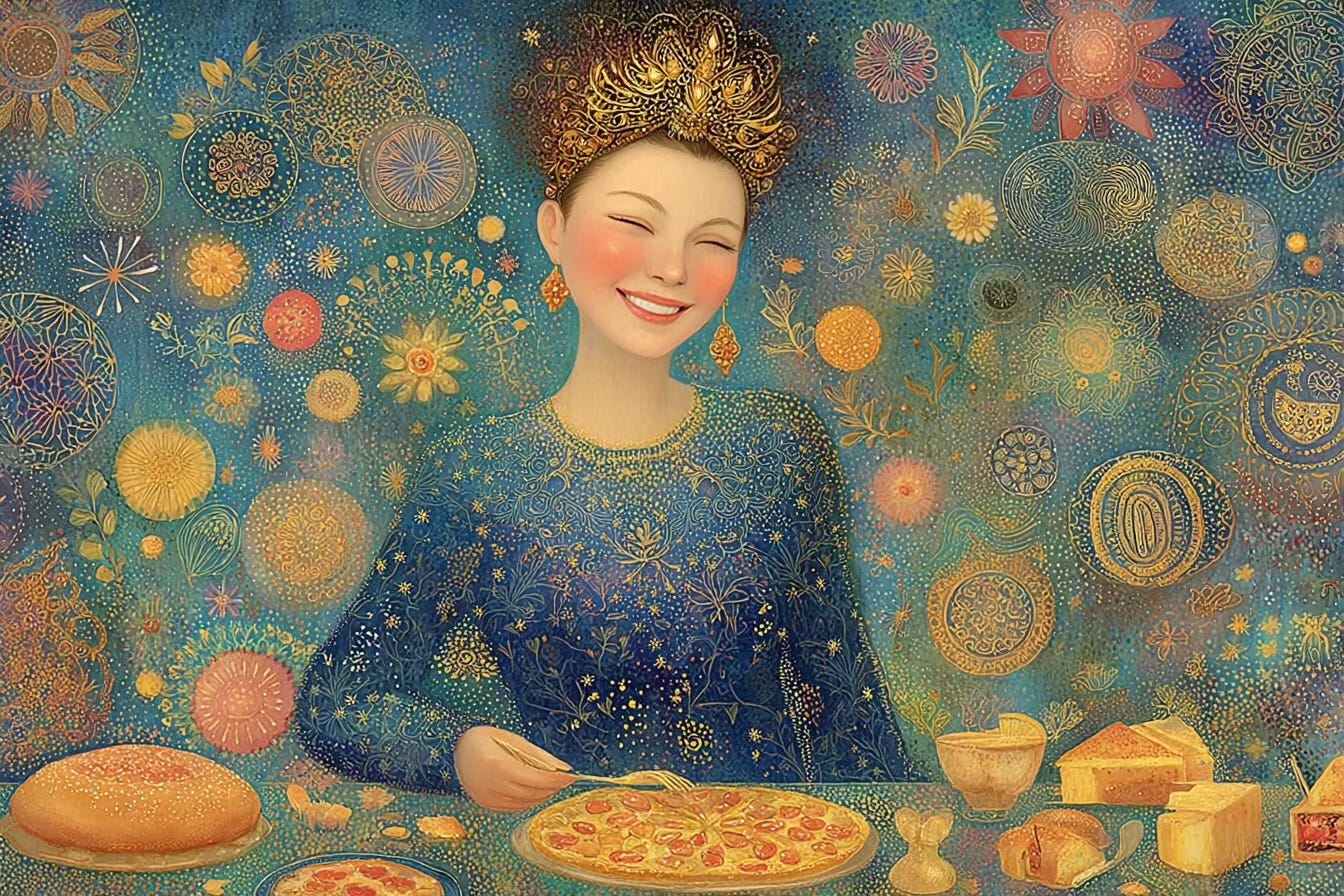
Food should be chosen by the body and Spirit, not by the mind. The mind loves complicated rules and regulations. But all of our food rules separate us from instinct.
The best dietary wisdom comes from our ancestors. What they ate is probably also the best thing for us to eat. Our ancient ancestors would distrust unrecognizable food covered in magic symbols. They would prefer whole, natural ingredients they recognized. We are also wise to stick to recognizable, traditional human foods. Packaging has repercussions in the astral. The less packaging, and magic symbols, on our food, the better.
They would certainly choose full-fat yoghurt over no-fat yoghurt. They would not want to exist on egg-whites and processed-protein-bran-weird-pea-flour-nothing-bars. In fact, you have to ask yourself if certain foods would actually ever be eaten if people didn’t think they were ‘good for you.’ Who, in their right minds, would choose Special-K over granola or eggs on buttered toast?
We’ve also been trained to believe energy comes from food, coffee, and other people. We are taught energy is found ‘out there’. But energy comes from Source, the essence of our Being. There is never any shortage of energy. It is ours because it is what we are.
Home cooking, with real ingredients, is good magic. It transmutes FFF.
Loving and Laughing at Every Weight
Levity and laughter are potently transmuting frequencies.
And the body, whatever its current weight, is often funny. It growls loudly in silent rooms. It sweats through the wrong shirt on the wrong day. It refuses to fit into last year’s trousers with no regard for our feelings. It wobbles, it shakes, it stretches, it sags, it protrudes. There is real medicine in laughing at all this.
A body can be loved at every weight. You’d love your dog or cat or child no matter how fat they were, wouldn’t you? Why not your own body? Levity, offered daily and on purpose, is its own kind of energy healing. It surprises the pattern. It tells the energetic arrangement of FFF something has changed.
Feeling Fat
But what is ‘feeling fat’? As already stated, we can ‘feel fat’ at any weight. It’s possible to be objectively slender, and still feel fat. Feeling fat’ is a shorthand for connecting with a certain frequency or layering of frequencies. That frequency is really a resistance we are holding in our field. It’s a cloudy mix of shame, grief, denial, fear, disgust, judgement.
Transmuting — releasing — the Feeling Fat Frequency will make us feel a million times better. And our bodies will probably reflect the transmutation. We’ll lose weight naturally, if we need to. But, even if we don’t, it doesn’t matter, because we will no longer be straitjacketed by ‘feeling fat’.
So I invite you now, to close your eyes, and see if you can tune into the feeling fat frequency. Can you identify it in your field? Does it have a color? A shape? A texture? And now, lift that frequency up. Send it up to the sun. Let it dissolve. Say, “I let this go. I send this out of my field.” Ask for higher help. Release Watch it turn to light. (For more about working with frequency you may want to explore this article The Twelve Laws of Frequency.)
The Weight Our Body Actually Wants to Be (Hint: It’s Usually Fatter Than We Think It Should Be)
Once fear and old instructions are out of the field, your body will settle at a weight. And it may be heavier than the weight your mind has been trained to want. It’s the set point your body actually wants to be. Obviously, this isn’t true of everyone. Many are simply naturally thin. Some have trouble gaining enough weight. Everyone’s different, I know. I’m talking in generalities.
But we have been taught to distrust our body’s set-point. We assume that if we stopped controlling, we would balloon indefinitely. But that’s the voice of the old starvation instruction talking, not the body’s true signal. A body left alone, fed with love, tends to find its own natural range and stay there. That range is almost never the range shown to us in magazines or fitness marketing. It’s usually softer and rounder.
A woman’s body carries fat differently than a man’s. It’s built to sustain fertility, nurse a child, and buffer against scarcity. Fat is a feature, deliberately built in. Hips, thighs, breasts, the soft curve of a belly. These aren’t the parts of us that went wrong. They are the parts of us doing exactly what they were built to do.
A body allowed to be at peace, rather than starved into compliance, may carry a little more flesh. That extra softness isn’t a sign that something has gone wrong. It’s may be a sign that vigilance has finally relaxed. The tension of being unnaturally thin - the tightened gut, the denial - dissolves. So too do the periods of excess weight gain. No more feeling fat, no matter what. Everything balances.
None of this means abandoning genuine health or fitness or balance. It means questioning whether the number you’ve fixated on was ever really right for you to begin with. Or whether it was inherited from ascetic nuns, corseted Victorians, and a 1990s runway. From “pinching an inch.” Ask your body directly what weight it wants to be. Not your mind or the mirror. Not the scale. The body itself, felt from the inside, at rest, unafraid. The answer is often heavier, yet calmer, than expected. And I can tell you, after years of hyper-vigilance, it feels so very good to just relax.
Disrupting the Feeling Fat Frequency

Everything above eventually points back to the same practical work. These are the three steps, applied here specifically to the FFF.
1) Name the energy
Instead of thinking “I feel fat”, try naming what’s actually underneath “feeling fat”. “This is grief.” “This is a fear.” “This is a numbness.” Or, perhaps, simply, “This is resistance.” Or, “This is a grey, blobby frequency.” Or, “This frequency feels sharp and jagged.”
We don’t have to name it perfectly. Simply trying to name it begins to loosen its power.
2) Disrupt the energetic pattern
We disrupt FFF when we do something unexpected. This might be something random or silly. Something new and surprising. We may eat the same snack sitting on the kitchen floor with a colander on our head, instead of standing. Why? Because it’s silly and different. This will disrupt the feeling fat frequency. We might move in a playful way rather than exercising as an act of penance. We might start wearing clothing and colors that feel alive rather than wearing ones we hide in.
Be creative. Cook something unexpected with real attention instead of eating on autopilot. Move the body to music instead of on a schedule. The frequency of joy and the frequency of feeling fat cannot occupy the same moment.
3) Return to presence
Before reaching for food out of habit, pause. Ask what feeling is actually present. Loneliness? Boredom? Grief? Speak it aloud instead of swallowing it with food.
The old instructions live in the past or the future, in old grief or feared judgment. The present moment, felt fully, transmutes feeling fat frequency. Feel the body that actually exists right now, not the one being compared to an ideal image in a magazine or a future goal.
The other practice is to slow down while eating and fully feel the moment. We can slow down far more than we think we can. Slowness is a super power. Food can be used to deny the present moment. That denial is later reflected back in a body that doesn’t match our highest blueprint. Slowing down and being present can heal so much.
Final words
The body is always listening. It’s always obeying whatever we tell it. Speak to it gently, and consciously. Listen to it. And it will show us exactly what it’s been protecting. It will show us when it’s ready to let that protection go.
Feeling fat frequency isn’t the enemy. It’s a messenger. It’s been trying, this whole time, to tell us something. It’s drawing our attention to grief, to fear, or to an old contract we made to stay unnoticed, or stay safe. It’s alerting us to our hidden shame. Not pious enough? Moral enough? Disciplined enough? Once heard, FFF doesn’t need to shout anymore.
Dissolving the FFF isn’t a single event. It’s a daily practice of observing the frequency the moment it rises. Naming it, and choosing not to strengthen it with more shame or fear. Each time we do this, our compounding energetic loops loosen a little further. Eventually, what’s left isn’t a number on a scale. It’s a body we’re actually living in and enjoying. Not something we’re managing, measuring, and resisting.
The real work isn’t becoming thin. It’s about reclaiming our freedom, at any weight.
If you enjoyed this article, you may be drawn to read my book, A Map of Secret Rivers: How to Navigate Timelines. It began as a year and a half of transmissions and became a practical manual for this work.
For those called to deeper work, I also offer Timeline Navigation Coaching.
For an index of all my articles, see here.
If you are reading to transmute your Feeling Fat Frequency, you may also find the 30 day LifeUnloop Challenge particularly helpful. More information can be found here.
Healing Deep-Seated Fear And Anger

You are sitting at home on your sofa, scrolling through funny memes on the Internet. Or, perhaps, you are shopping for new shoes. Either way, you are munching on caramel popcorn and sipping on root-beer. The sun is shining outside. The skies are blue.
You have to feel “Enough “ to break up with the eating-disordered world. People I know upping their dose of Ozempic are in it for vanity. And landing in the Emergency Room. Thanks for sharing!
🩷