
Reality Transurfing Unpacked
An In-depth Guide to Vadim Zeland's Model of Reality

I spent all of 2019 reading Vadim Zeland. I read his books back to back, then back again. Zeland gave me language for things I had always sensed without having the words. His work forever changed my life. No writer has influenced me more.
Transurfing is a coherent model of how reality is structured and how we move through it. It is the most sophisticated framework for understanding consciousness I have ever read.
Zeland’s work isn’t easy to access. The series runs to five volumes. It is translated from Russian, and the translation is sometimes awkward. The concepts are dense and build on each other. Many people encounter Transurfing through a simplistic summary or a YouTube video. They get a glimpse of something important, but never quite reach the depth of the original.
This article is an attempt to remedy that. What follows is a complete guide to Transurfing’s core concepts, explored in depth. I have also connected them to parallel traditions to give more context. You do not need to have read Zeland to benefit from this article. If you have read him, I hope it gives you something to return to.
This article includes a four-minute visual guide to Zeland's core concepts, with original art and music. You will find it further down the page.
The Space of Variations: An Infinite Library of Worlds

“When the parameters of thought energy change, a shift occurs to a different life line”
― Vadim Zeland, Reality Transurfing Steps I-V
Zeland opens his entire framework with a proposition.
Reality, he says, is not a single line that we travel along. It is an information field of infinite variations. Every possible version of every possible event, already exists, and is waiting. He calls this the Space of Variations. Think of it a vast, silent library containing every book that could ever be written. It contains every life that could ever be lived and every morning that could ever be woken into. All of it, already there.
In this model, we don’t create our reality. Instead, we select it. Our consciousness moves through the Space of Variations like a tuning fork. It resonates with the frequencies that match its own. It draws those variations into material form through resonance. We don’t move through this field by effort or will, but by frequency. Our dominant emotional and mental state acts as a tuning signal. It draws the sectors of the Space of Variations that resonate with it.
In 1957, physicist Hugh Everett III proposed the Many-Worlds Interpretation of quantum mechanics. Quantum superposition proves that particles exist in multiple states simultaneously until observed. Everett suggested that every quantum event causes the universe to branch. Every outcome occurs, in its own branch of an ever-proliferating multiverse. The equations, he argued, do not support collapse into a single reality. They support the continuous flowering of all realities.
Mainstream physics has never embraced Everett. But neither has it refuted him. The Many-Worlds Interpretation remains one of the most coherent ideas in physics. And it maps, with startling precision, onto Zeland’s Space of Variations.
The ancient Hindus had their own version. The concept of the Akashic Records is found across Vedic and Theosophical traditions. It has been embraced by the New Age movement. It describes an etheric field containing every possibility that has ever existed. The word Akasha comes from Sanskrit. It means sky, space, ether. It is the fifth element, the substrate beneath the other four. It is an informational structure. The Space of Variations and the Akashic field are the same thing, but with different names.
The Space of Variation describes something humanity has always known, deep down. Reality is larger than the sliver of it we currently inhabit.
Importance: The Weight That Holds You Still
“Excess potential is only created when you attribute excess importance to an object or event that exists inside or outside of yourself.”
― Vadim Zeland, Reality Transurfing Steps I-V
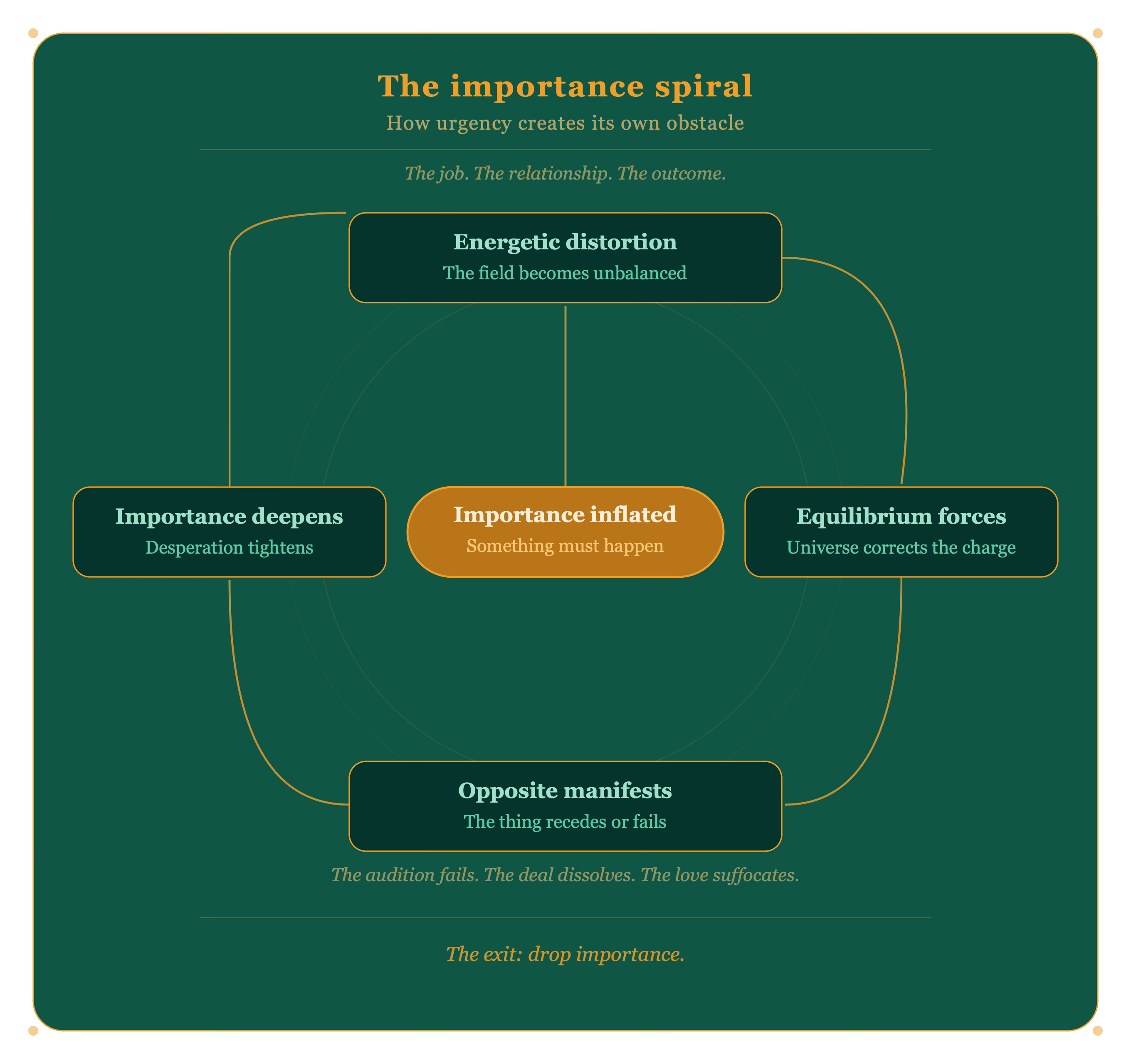
In Zeland’s model, Excess Potential is the energetic imbalance created by inflated Importance. It trigger automatic corrective forces. Importance is the charge we place on something. It’s the energetic weight of how much it matters, how much we need it, how catastrophic it would be to lose it or not have it.
When we inflate significance, we create a distortion in our energetic field. Zeland calls the forces that respond to this distortion ‘Equilizing Forces’ or ‘Balancing Forces’. The universe, he says, is a balancing system. Corrective forces don’t care about your wishes. They care only about restoring equilibrium. And the most efficient way to restore equilibrium is to deflate what you have inflated.
This is why the thing we desperately need tends to recede. Why the relationship we cling to suffocates. Why the audition we are desperate to nail makes our hands shake. Importance generates forces working against us.
Epictetus built his entire philosophy around a single distinction. There are things within our control and things outside it. He was not asking people to stop caring. He was asking them to stop attaching to things beyond their control. He called it apatheia. It was the state of being unmoved by what is not ours to control. It is functionally identical to what Zeland calls dropping Importance.
The Taoists have a word for it: wu wei. Non-action. Non-forcing. The Tao Te Ching returns again and again to this principle. The reed bends in the storm and survives. The oak resists and breaks. Water, Laozi says, is the softest substance in the world and yet it wears down stone. It does not fight. It does not strain. It moves along the path of least resistance and in doing so goes everywhere.
We have a contemporary parallel in what psychologists call the paradox of control. The harder people try to control outcomes, the more likely those outcomes are to elude them. The effort itself creates the opposite effect.
The Bhagavad Gita calls it nishkama karma. This means, “action without attachment to fruit”. Krishna’s instruction to Arjuna on the battlefield of Kurukshetra is precisely this. Do your work, play your part, act with full commitment, but release the outcome. The action is yours. The result belongs to the field.
Zeland’s Equalizing Forces are the storm. Importance is the oak. Dropping importance is learning to be water.
Pendulums: The Structures That Feed on You
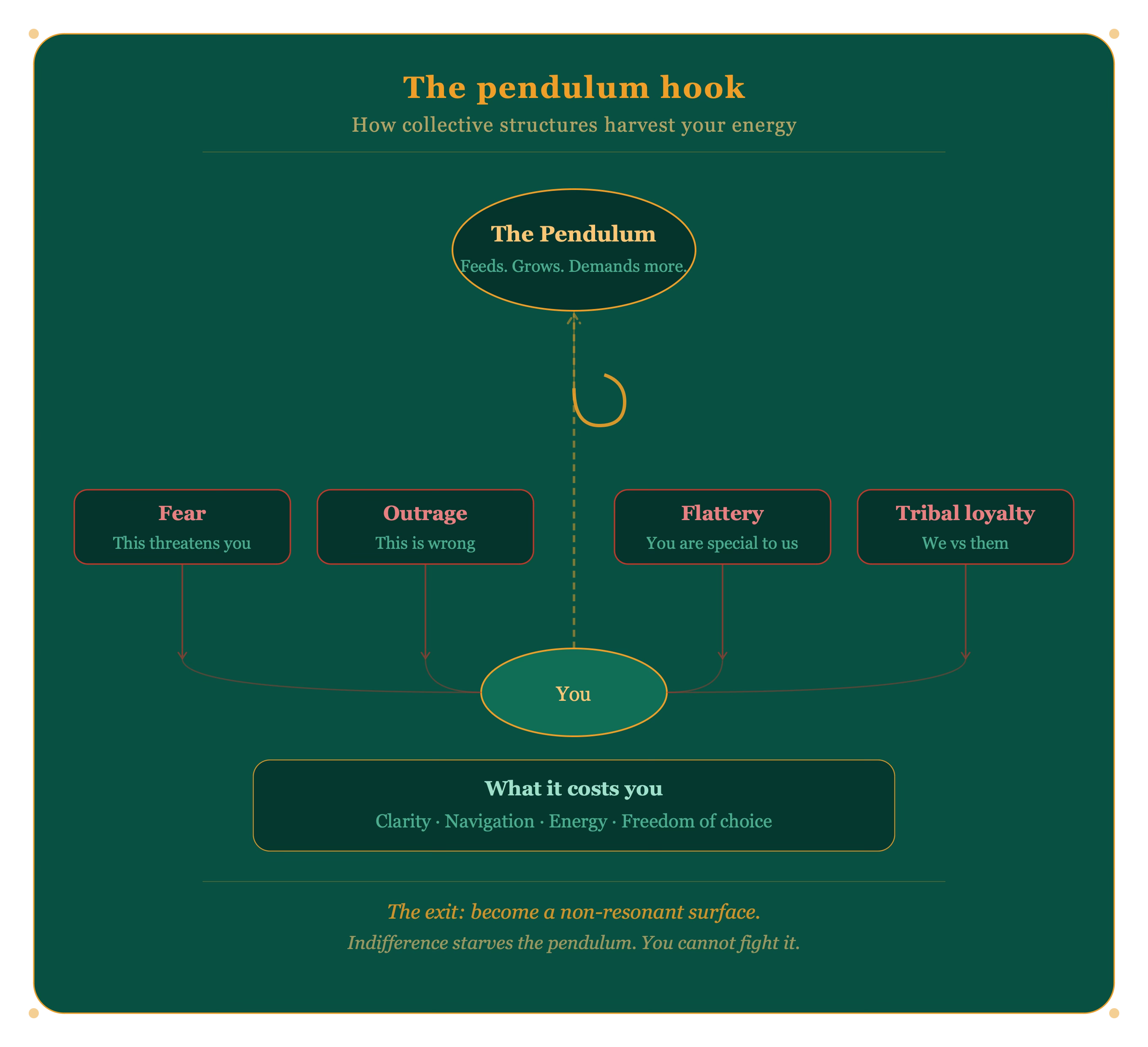
A Pendulum, in Transurfing, is an energy-informational structure. It arises when groups of people direct their attention toward the same thing. It is, in the most literal sense, a collective thought-form. It is an entity that has no body, consciousness, or agenda of its own. But it has an overwhelming drive to sustain itself by harvesting energy.
Pendulums are not conscious enough to be evil. They are more like weather systems. Vast, impersonal forces that develop their own momentum. They will sweep up anything in their path because that is what they do.
Every institution is a pendulum. Every ideology, institutional religion, political party, corporation and trend is a pendulum. War is a pendulum. Every financial or moral panic is a pendulum. The fashion and the wellness industry are pendulum. So is any spiritual movement that has accumulated enough followers to become self-sustaining. This includes, Zeland notes with characteristic honesty, Transurfing itself.
The Pendulum’s primary tool is destabilisation. It doesn’t need our love or our hate. It needs our energy, and our energy can be taken when we have been knocked off centre. Fear , outrage, anxiety, and tribal loyalty can all knock us off center. What matters is that our internal equilibrium has been disrupted. Then our attention is hooked and we are now feeding the structure.
This is the mechanism behind the news, social media, political polarisation, and advertising. All of these are, in Zeland’s framework, Pendulum technologies. They have been refined over decades. The average person’s attention is harvested continuously.
Carl Jung described something similar with the concept of complexes. These are autonomous psychic structures that capture the energy of the psyche. When a complex is activated, the ego doesn’t decide to respond. Rather, the complex responds through the ego. The person finds themselves compelled, without quite knowing why.
The anthropologist Émile Durkheim documented collective effervescence. This is the phoenomen hat arises in crowds, where individual identity dissolves. He observed it in religious rituals, in public celebrations, in political rallies.
In ancient myth, the Minotaur is the figure that maps most precisely onto the Pendulum. The labyrinth at Knossos was a structure so complex that no one who entered it unaided could find their way out. The monster at the centre demanded a tribute of young Athenians. The labyrinth itself is the Pendulum’s architecture. It is a structure designed to ensure a steady supply of energy for the Minotaur.
Theseus is the hero who kills the Minotaur. He uses Ariadne’s thread as a line of connection to something beyond the Pendulum’s reach. This allows him to move through the labyrinth without being consumed by it. The thread is consciousness.
Zeland’s advice for Pendulums maps onto Theseus almost exactly. You can’t fight a Pendulum. Fighting it is another way of feeding it. You can only withdraw your energy from it. Become empty, indifferent, a non-resonant surface. The Pendulum can’t hook what it can’t find purchase on.
The specific practice Zeland recommends is what he calls becoming an outsider. He recommends stepping back from the emotional charge of the situation. The Stoic prosoche is about sustained attention to the quality of one’s own mental state. It is the same practice in a different century.
Visualization and the Process of Moving
Zeland draws a careful distinction between two different uses of imagination.
The first is visualization of the finished outcome. This, he says, is energetically problematic. Focusing intensely on the desired end state tends to inflate its importance. The more vividly we hold the goal before us like a prize, the more the frequency of lacking it can creep into our signal. The goal becomes something we need and something we are separated from. The need and the separation are what our frequency broadcasts.
The second is visualization of the process. It is about visualizing the journey, not the prize but the doing. Imagine yourself moving through the stages. Imagine the work, the daily texture of it, the specific actions that comprise the path. This kind of visualization is different in its effect because it is inhabited. You are inside it, doing it. The frequency it creates is not the frequency of wanting but the frequency of having.
This maps precisely onto what psychologists call process visualization versus outcome visualization. Research by Gabriele Oettingen and others has demonstrated that outcome visualization reduces performance. It triggers the same neural reward pathways as actually achieving the goal. Therefore, it reduces the motivational pressure to act. Process visualization, by contrast, improves performance. It rehearses the pathway, builds confidence, and maintains the orientation of action.
The hero’s journey, as Campbell mapped it, is a process, not a destination. The hero does not know, at the outset, what the Grail will look like or where it will be found. What the hero knows is the next step and the willingness to take it. The Grail itself is not the point. The capacity that is built through the journey is the point. And the Grail, in the end, is a Slide made real.
Intent: The Only Thing That Actually Moves You
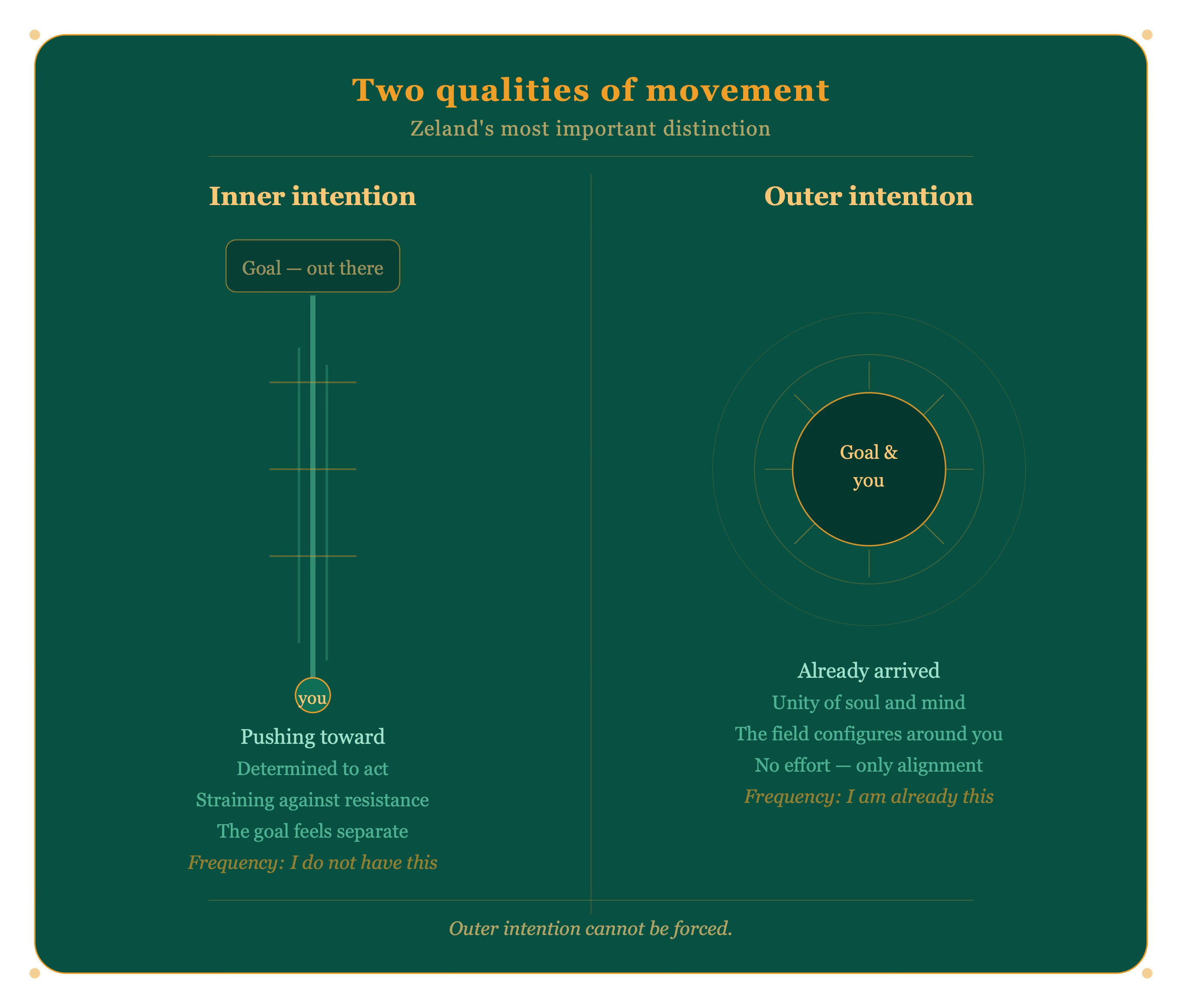
Zeland makes a distinction that took me longer to understand than anything else in his work. I now consider one of the most important ideas I have ever encountered.
He divides what we might call motivation or will into two different things. These are Inner Intention and Outer Intention.
Inner Intention is what we mean when we talk about trying to make something happen. It is the determination to act, to push, to apply effort to the world and bend it toward our chosen outcome. It is what most goal-setting, productivity culture, and manifesting advice is based on. Do more. Work harder. Visualise and then hustle. Inner Intention is the engine of conventional ambition. It is the wrong tool for changing which Timeline we inhabit.
Outer Intention is different. It isn’t trying harder. It isn’t trying at all, in the conventional sense. Outer Intention is the state in which we have already aligned with the reality we are choosing. It is not about reaching toward the goal but inhabiting the frequency of having arrived at it. From that state, the field itself begins to configure around us. The circumstances align. The doors open.
Zeland says Outer Intention arises from the unity of soul and mind. It is not a thought we think, but a state we become. It is a knowing without logic, a confidence without effort. He also says it can’t be manufactured by Inner Intention. We can’t push our way into it. We can only create the conditions in which it becomes available. We do this by dropping Importance and withdrawing from the Pendulums.
The distinction maps onto what psychologist Mihaly Csikszentmihalyi called Flow. This is the state in which action becomes effortless. The performer and the performance merge and results arrive without strain. Athletes call it being in the zone. Musicians call it playing through the music rather than playing the music. In Flow, the Inner Intention machinery goes quiet, and something larger moves through. Csikszentmihalyi’s research showed that Flow produces dramatically better outcomes than effortful striving.
The quantum parallel here is resonance. In quantum field theory, a particle doesn’t get energy by being hit. It acquires energy by resonating with a field at its own frequency. The energy transfer happens not through impact but through alignment. Outer Intention is resonance. Inner Intention is impact. And the universe, it turns out, is a resonance system.
In the story of King Arthur, hundreds of knights tried to pull Excalibur free. All of them applied maximum Inner Intention. They used their muscle, leverage, willpower, and entitlement. None of them could move it. Arthur approached without the weight of what it would mean, and the sword came free in his hand. The stone yields to Outer Intention.
The Wave of Fortune: How Positive Lines Compound

Luck, in ordinary language, is random. It is something that happens to us, unearned and unpredictable. It is unrelated to who we are or what we have been doing. Zeland disagrees with this.
In his model, what we call luck happens when we move through positive sectors in the Space of Variations. He calls tit the Wave of Fortune. Once we enter the wave, the next positive event follows. Success compounds. Good things arrive in clusters. And this is not coincidence. The Space of Variations groups similar variations together.
The critical insight is that the Wave of Fortune is entered through small positives. We don’t get access to the wave by waiting for a big win. We get access by recognising and amplifying the small wins. The wins signal that we are on the wave.
This is why gratitude practices are navigational tools. When we amplify positive experience we are resonating with more positive sectors. The Stoic practice of amor fati - love of fate or the full embrace of what is - serves a similar function.
In complexity science, this is understood as the Matthew Effect. It is named for the biblical principle: to him who has, more will be given. Sociologist Robert Merton documented how success shows the same non-linear pattern. Early advantages compound, creating disproportionate outcomes over time. The rich get richer and the lucky get luckier. This is how positive states propagate through complex systems.
Persephone, in Greek myth, is a figure of seasonal luck. Her descent into the underworld and return to the surface follow a rhythm. The farmer who understands this rhythm plants and harvests in alignment with it. The farmer who ignores it plants at the wrong time and loses the crop. The Wave of Fortune has its own rhythm.
The Current of Variations: Moving with What Is
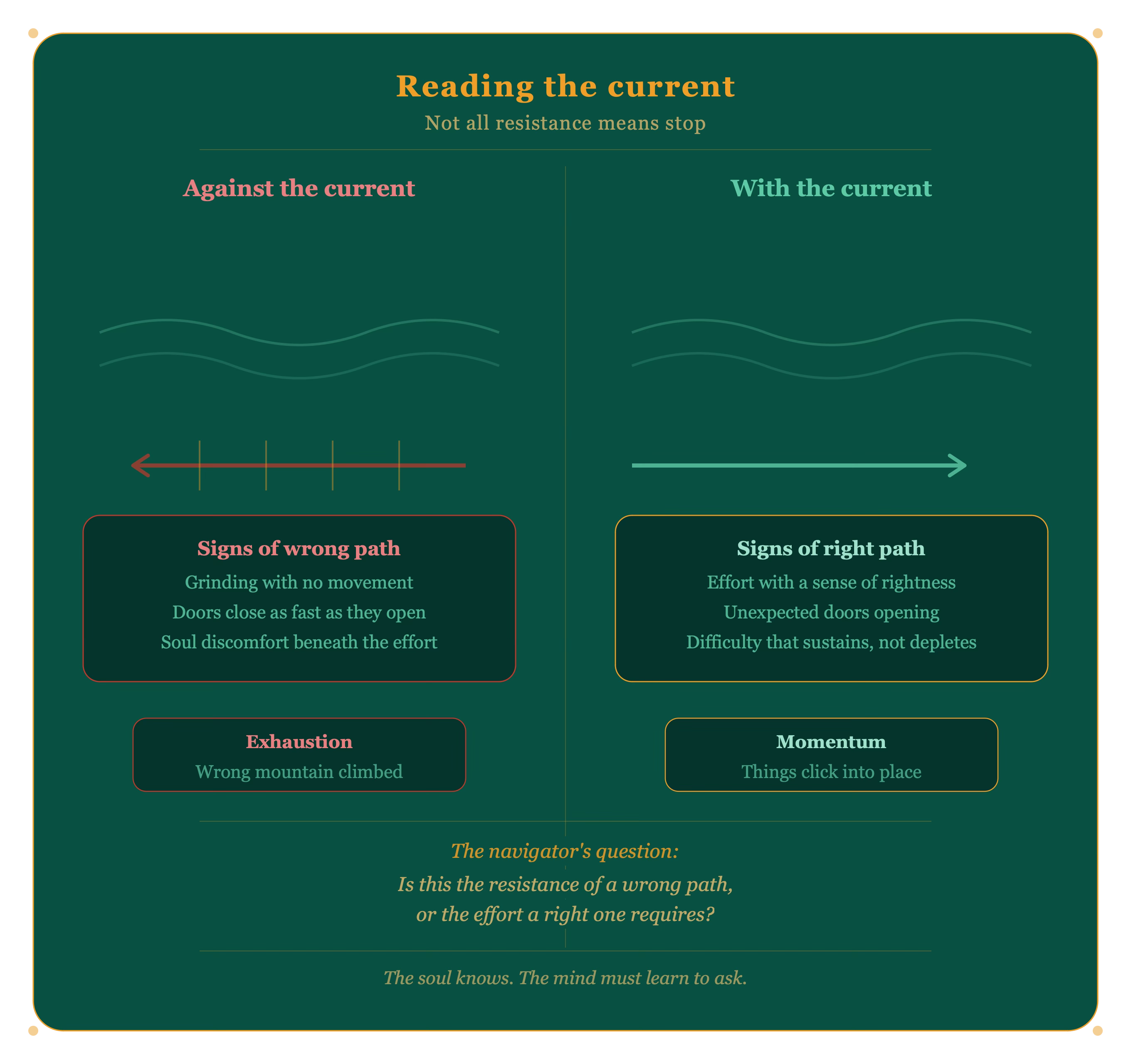
The Space of Variations isn’t random in its organisation. Certain paths through it are more available than others. They are more energetically efficient and in alignment with the field’s structure. The Current flows along these paths the way a river flows through the landscape. Zeland’s instruction is simple: move with the current, not against it.
It means distinguishing between types of resistance. There is resistance that signals a wrong path. And there is resistance that is resistance to effort. Not all difficulty is a sign to stop. Effort that produces no movement is often a signal that we are paddling against the current.
The Tao Te Ching’s central image is water finding its way to the sea. Laozi’s water doesn’t fight the rock. It goes around, under, and through the cracks. In doing so it moves faster and further than anything that tries to push through.
In practical terms, the Current of Variations shows up as the sense of things clicking into place. The right person appears at the right moment. There is an unexpected opening. The obstacle that turns into a detour turns out to be the better route. The navigator who flows with the current doesn’t arrive by force. They arrive because they stopped fighting the water
Slides: The Stories We Live Inside
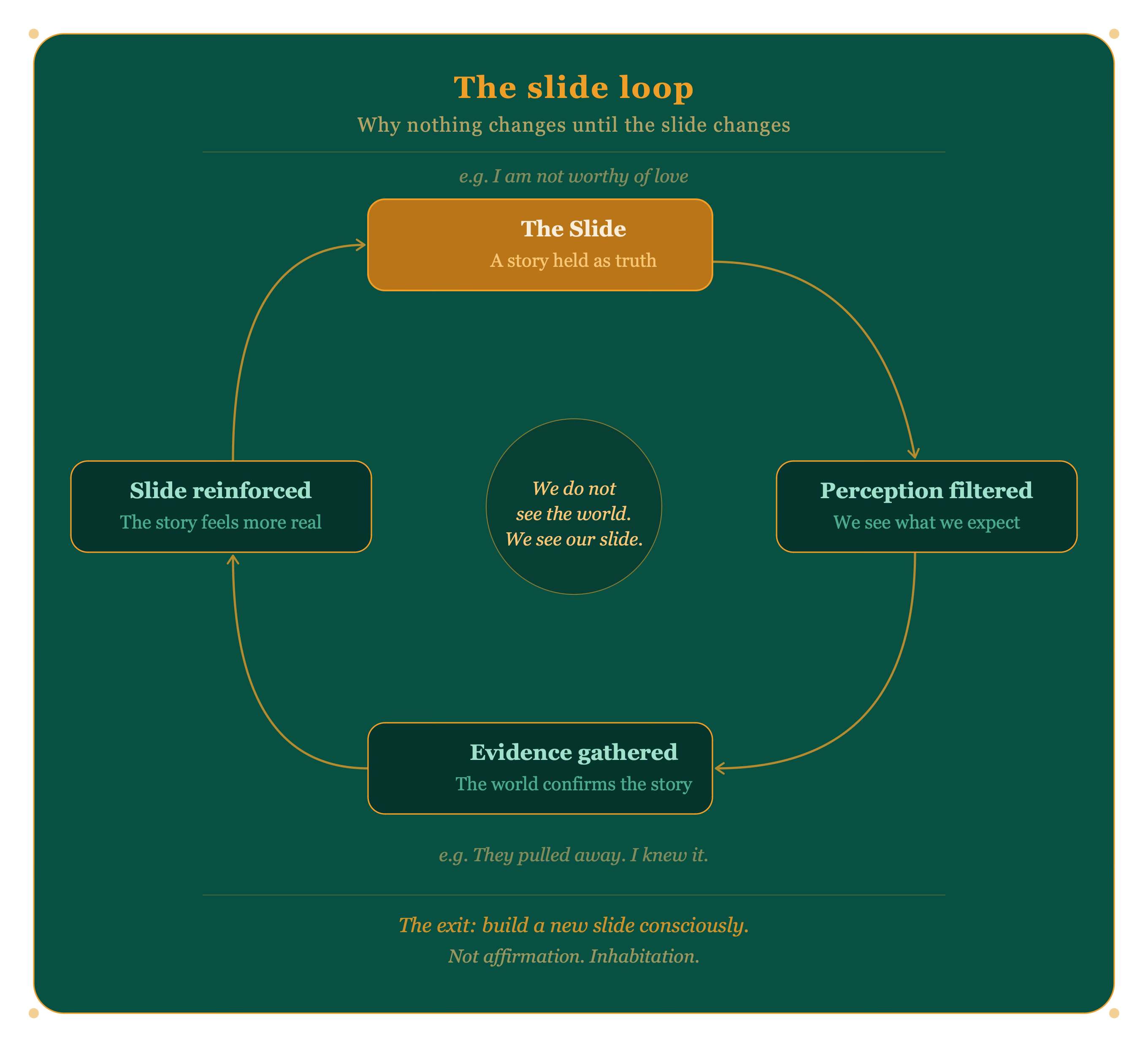
A Slide, in Zeland’s view, is a mental-emotional picture of reality. It is built from memory, expectation, fear, and desire. It filters and colours everything that is perceived. We don’t see the world. We see our Slide of the world.
Negative Slides are the stories in which we are likely to fail. They are built from old experiences and internalised voices. And because we live inside them rather than seeing them from the outside, we take them for reality. The Slide is invisible as a Slide. It just feels like the truth.
A negative Slide effects our resonant signal as we move through the Space of Variations. It steers us toward the sectors of the field that will confirm it. The person who believes they are unlovable finds evidence of this. The Slide creates its own confirmation.
Zeland’s prescription is to build positive Slides consciously. These are not affirmations in the shallow sense of repeating things we don’t believe. Instead, we inhabit the version of ourselves who has arrived at the desired Timeline.
This is imaginative work of a serious kind. It is what William Blake was doing when he wrote: “If the doors of perception were cleansed, everything would appear to man as it is — infinite.” The doors of perception, in Zeland’s language, are the Slides. Blake spent his life trying to see past the “mind-forged manacles”.
The Jungian concept of the persona is the mask the ego constructs to meet the world. If we identify with our persona, we live in a compressed, defended version of reality. Jung taught people to see their constructed identity, as distinct from the Self.
Neuroscience has a predictive processing theory. It proposes that the brain doesn’t passively receive sensory information. It generates predictions about what it expects to perceive. In other words: the brain tends to see what it expects to see. The Slide is, in this framework, not metaphor but mechanism. Our stories shape the neural processing through which we encounter reality.
Induced Transition: How We Drag Ourselves into Darkness
We aren’t disturbed because bad things are happening. Our disturbance is moving us toward the variations where bad things happen. The emotional response to a negative event is not merely a reaction to it. It is the mechanism that induces it. The response itself is the transition.
Zeland is describing how consciousness navigates the field. If our frequency is fear, we tune our signal to the sectors of the Space of Variations where there is more to fear. Our media is structured around negative emotional induction. Outrage, fear, anxiety pull the navigator toward negative sectors.
In the story of Odysseus, the Sirens’ song pulls sailors off course. This is due to their own response, not through force. Those who fear it and react are destroyed. Odysseus survives by remaining conscious and unmoved. He is present to the danger, but not captured by it. This is the inner state Zeland is pointing to.
Zeland’s advice: don’t actively avoid the bad stuff, but don’t consume it either. Maintain the inner state of an outsider. Be aware and informed, but not swept into the emotional current of the Pendulum.
Goals and Doors: Yours and Not Yours
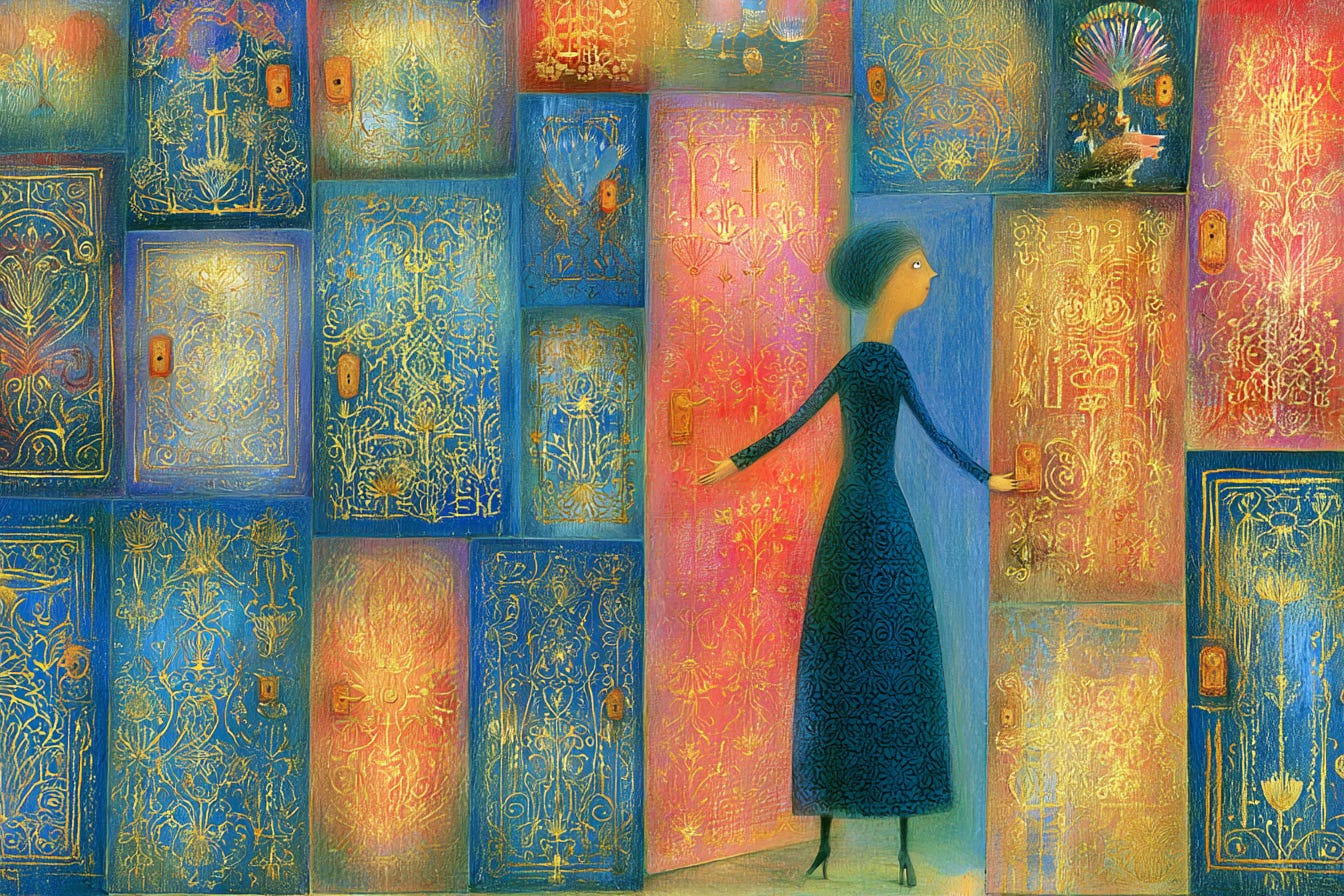
“If you have to convince yourself and talk yourself into saying “yes”, then your soul is really saying “no.” When your soul says “yes”, you do not have to talk yourself round.”
― Vadim Zeland, Reality Transurfing Steps I-V
Your Goal, Zeland says, is the thing that makes life feel like a feast. It isn’t the thing that impresses. It isn’t always the practical thing, or the thing likely to be recognised. It is the thing that, when you imagine it, produces the most internal aliveness.
Your Door is the specific path toward that goal. It feels like fascination rather than duty. It is the one on which, even when it is difficult, there is a quality of rightness that sustains you.
Psychologists Edward Deci and Richard Ryan spent decades researching human motivation. Their Self-Determination Theory distinguishes between intrinsic and extrinsic motivation. — Intrinsic motivation is doing something because it ismeaningful to us. Extrinsic motivation is doing it for reward, recognition, or approval. The findings are unambiguous. Intrinsic motivation produces sustained engagement, creativity, and wellbeing. Extrinsic motivation produces performance that collapses the moment the reward is removed. Someone else’s Goal is always extrinsic, even if has been internalised.
Chekhov understood this. In The Bishop, a man has achieved everything expected of him. He is beloved, respected, elevated. He has climbed every rung he was supposed to climb. And yet he weeps without knowing why.
Someone else’s Goal will always produce discomfort that no achievement can resolve. You can reach the summit of someone else’s mountain and find it empty. The discomfort does not go away when you arrive. It intensifies, because now you must acknowledge that you climbed the wrong mountain.
Rustle of Morning Stars: The Soul as Navigator
“If you stop the train of thoughts and simply contemplate the emptiness, you will hear the rustle of the morning stars, the inner voice that has no words.”
― Vadim Zeland, Reality Transurfing Steps I-V
Beneath the noise of the mind, there is something that knows.
Zeland calls it the Soul’s whisper, and he gives it a beautiful name: The Rustle of Morning Stars. It is the quiet knowing that arises before the mind has had time to argue with it. It is the immediate knowing that arrives before the reasoning starts.
Zeland’s sixth rule: if you have to persuade yourself, the soul is saying no.
When we are aligned with a path, we don’t need convincing. When we are on the wrong path, no amount of logical justification quiets the discomfort. The mind can construct a perfect case. The soul shakes its head.
The Greeks called this the daimon. It is the inner guiding spirit that Socrates described hearing as a voice that told him what not to do. When he was about to make a wrong move, the daimon would say no.
Neuroscientific research has shown that the body knows before the conscious mind. Patients with damage to the ventromedial prefrontal cortex lose this capacity. As a result, they make bad decisions despite their intelligence remaining intact. The gut feeling, the somatic sense of rightness or wrongness, is a rapid integration of data.
Soul Fraile: The Frequency That Is Yours Alone
The Soul Fraile is, for many readers, the most transformative part of Zeland’s work. The Soul Fraile is something that is completely you. It is your unique configuration of soul. When expressed without interference, it carries its own luminosity.
The Soul Fraile is what is left when everything that has been imposed is allowed to fall away. It is the frequency that is yours alone, the note that only you can sound in the orchestra of existence.
When we are aligned with our Soul Fraile, something that Zeland calls Shine appears. It is the quality of a person who is entirely themselves. Present, unhesitating, sufficient. You can feel, in their presence, that they are not trying to be anything other than what they are. This is rare and magnetic.
Pendulums work against the Soul Fraile. They offer alternative identities, images of who you should want to be. They feed on the energy generated by the gap between who we are and who we are trying to become.
Hildegard of Bingen was a twelfth-century mystic and polymath. She wrote about viriditas. This was the greenness, vitality, the living force that animates all created things. Each creature, she believed, had its own specific viriditas. This was the particular quality of life-force that expressed its unique created nature. When a creature was living in alignment with its viriditas, it flourished. When it was bent against its nature by external forces, it withered. The Soul Fraile is Hildegard’s viriditas in Zeland’s language.
In physics, every particle has its own specific quantum numbers. This is a unique set of properties that define what it is and how it interacts with the field. No two electrons are identical in the precise configuration of their quantum state. The Soul Fraile is our quantum signature. And the universe responds when we are transmitting it without distortion.
What Transurfing Gives Us
Zeland’s model is a set of tools.
The Space of Variations exists whether we work with it consciously or not. We are already moving through it. The only question is whether we are navigating with lucidity. Transurfing transforms our relationship with reality. The desperation softens. The grasping loosens. The quiet signal beneath the noise becomes audible. We begin to notice when we are are feeding a Pendulum. We recognize the grinding push of Inner Intention. We surrender to the gentleness of Outer Intention. We connect with our Soul Fraile.
This work requires sustained attention. It requires the willingness to drop our attachments. It takes courage to trust the signals that the mind cannot always verify.
Zeland also writes about the Plait. I explore this in my article, How to Assemble Timelines.
If you enjoyed this article, you may be drawn to read my book, A Map of Secret Rivers: How to Navigate Timelines. It began as a year and a half of transmissions and became a practical manual for this work.
For those called to deeper work, I also offer Timeline Navigation Coaching.
Unhappening - A Metaphysical Framework for Healing Time

We usually perceive cause and effect to be traveling in one direction only. Something happens. We respond. The event came first. Our reaction followed. These are the rules of linear time. We have accepted these rules so completely that they seem to be irrefutable.
A beautiful piece and I love the art!
I will add when a philosophical system focuses exclusively on mechanics, observation, and detached navigation, it loses its heart. In other words this is missing the feminine aspect of consciousness.
Hermetic Wisdom is a very good read as well, but again it lacks the feminine principal. I have written about the missing feminine in Hermetic Wisdom, perhaps you would be interested...https://graceainslie.substack.com/p/balancing-hermetic-wisdom-255?utm_source=publication-search.....Have a great day!
Pippa, you've done it again.
So many of these ideas are either hidden behind dense language or presented in ways that make them inaccessible to people who are new to the conversation or simply don't have the time to wade through complexity. You have a rare gift for distilling profound concepts without diminishing them.
What I appreciate most is that you don't oversimplify. You make the material approachable while preserving its depth and nuance. That is a genuine service. It broadens the reach of important teachings and creates an entry point for people who are curious, seeking, and ready to awaken, but may not know where to begin.
Many valuable teachings never reach the people who would benefit from them because they remain hidden behind complexity, specialized language, or competing interpretations. Your writing serves as a bridge. In my view, that's a profound service. There are many teachers, but very few translators. You have a gift, and I am grateful that you continue sharing it. 🙏🏽