
In the Future We Communicate Through Dance, Humor and Poetry
What I saw when I traveled forward in time

What I am about to tell you falls into the category I call High Strangeness. I offer it not as proof of anything, but as a first-hand account of what I experienced. Make of it what you will.
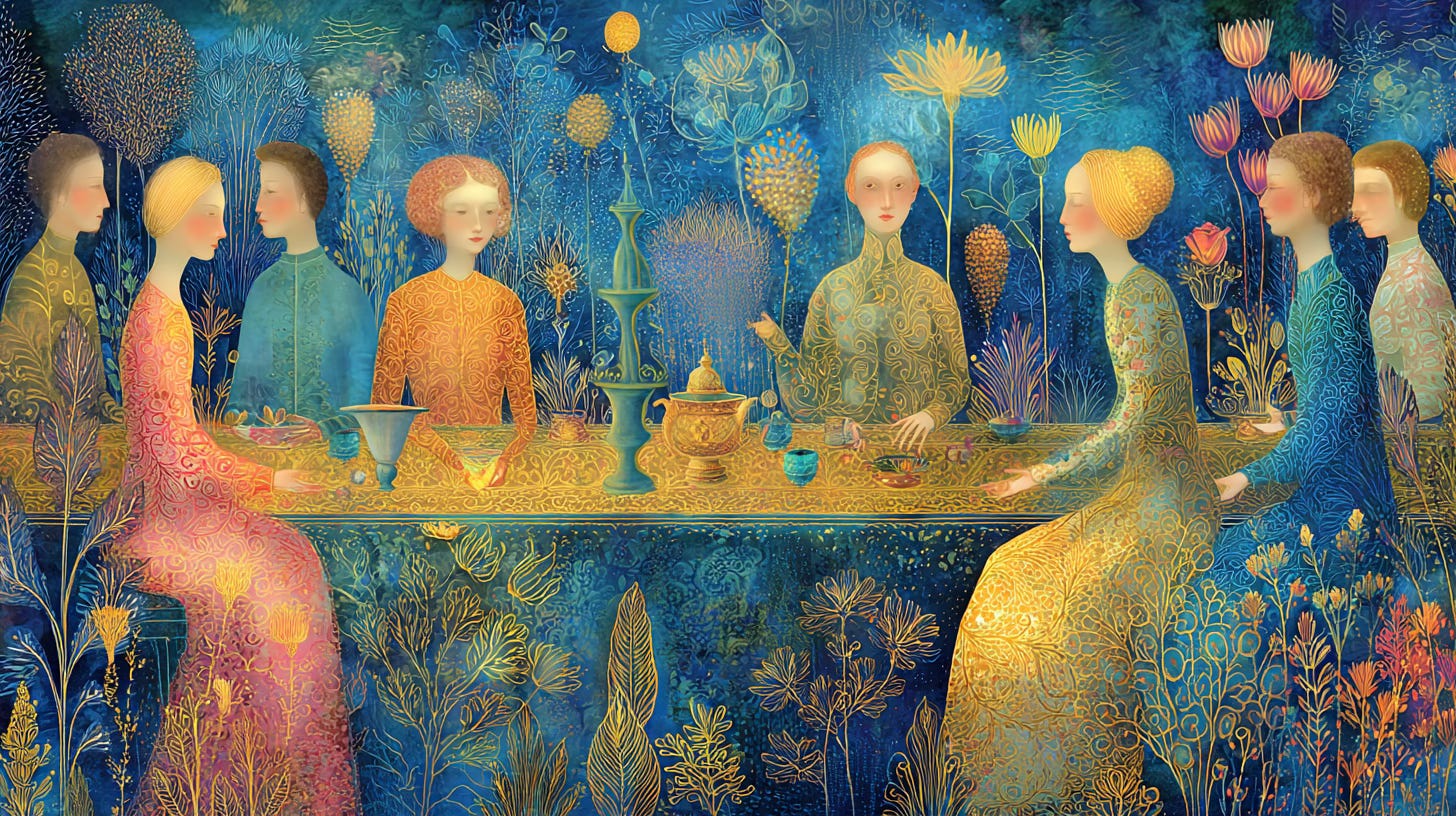
I walked through large, tall white doors into a courtyard. There were fountains, and beautiful plants. There was a long wooden table with people sitting around it. They were wearing beautiful, jeweled colored clothing. There was a large white building that may have been made of marble or glass.
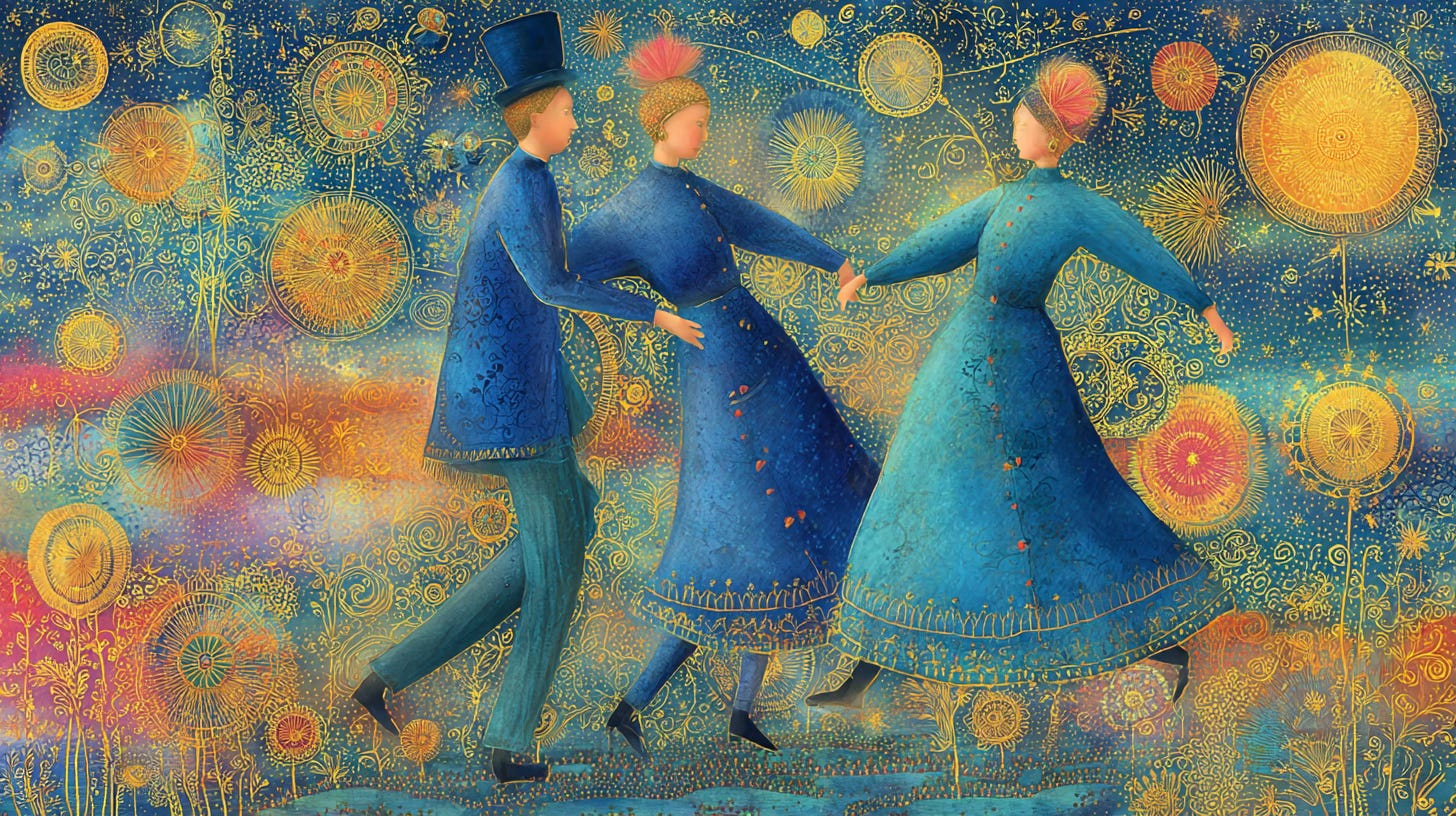
As I arrived, a man stood to greet me. He was friendly. He greeted me with dance. These were refined, ritualized movements. I understood, without anyone telling me, that they were the language of this place. This was how people communicated here. And I knew the movements too. My body knew them already. There was humor and joy in the movements.
It was at this point that I became lucid.
I had Timeline Jumped.
I wish I could tell you I remembered the Protocol. I didn’t. But I felt none of the usual disorientation or fear that accompanies extreme Jumps. Instead I felt something I can only describe as recognition. I had merged with my Future Self. I was home.
There were others around the table. They were friendly, attractive, young-appearing people. I also knew they weren’t necessarily young at all. They had the dignified bearing of older people, but the appearance of youth. I knew these were my friends. More than friends. They were my people. When we spoke, it was in snippets of verse and jokes. All communication was in highly refined poetry, humor, or in dance. We were English, a small, highly evolved group. I somehow knew that we were the remaining survivors of English civilization.
Overhead, very high up, there were bridges or elevated roadways. They had small white bullet-shaped trains moving along them. They may not have been trains, but that is how my mind is able to understand them now. I noticed them but didn’t pay attention to them. I took them for granted, as a feature of my existence there. They weren’t what mattered. What mattered was the table, the people, the wide blue sky above it all.
I wanted a drink. The moment I thought this, a cool lemonade appeared before me. Ice. Fresh mint. It was exactly what I had wanted. I hadn’t asked for it. I had desired it, and the environment had responded.
Because the environment was responsive. The air itself was a kind of AI so advanced it had become indistinguishable from magic. It could hear any thought, read any desire, and provide it immediately. There was no separation between wanting something and receiving it. None at all. It was like being inside virtual reality except it felt very real and sensory. There was a soft, warm breeze. Everything seemed to be perfectly designed for our comfort. The lemonade was cold and perfect in my hand.
The return
And then, drinking that lemonade, I had a thought. This is where I belong. I will stay here.
The moment I thought it, I felt the familiar sensation. It was like falling upward through a tunnel at enormous speed, and then...
Voompf.
My familiar bed. My familiar room. Nighttime, still. Everything exactly as it had been before. The moment I tried to hold on to it, it released me back to now.
I lay there, orienting. My heart was racing. I was disappointed to have left where I was. And then, with a clarity like a transmission, I understood something.
I am from that future. My task is to create a bridge between that future and now. That is my mission
The experience gave me something more than an interesting story to tell. It gave me a deeper, more visceral, understanding of what Timeline Jumping actually is.
We don’t move our old self to a new location. We merge with another version of ourselves who is already there. For a brief period we may retain the memories of the self we came from. We remember the bed we fell asleep in, the life we had been living. And then, if we stay, those memories fade. The new self absorbs us completely. We become them. We always were them.
This is why Timeline Jumping can feel like remembering rather than travelling. We are not going somewhere new. We are merging with a self who has always existed, who has always lived that life, who already knows the dance.
The future self I merged with that night was already at the table. Already had friends, and a courtyard. They lived in a civilisation built on ritualized poetry, jokes and dance. It was a world that answered thoughts with lemonade and mint. I should add that I am not certain if I was female in that Timeline. If anything, I believe I may have been male. I include this not as a curiosity but because it matters to the framework. If we merge with other versions of ourselves, then what we think of as fixed may be more fluid than we imagine. The external clothing of the Self isn’t a constant. We can take many forms.
I was not visiting that future self. I was that future self, remembering what it felt like to be me. That distinction changes everything about how we navigate. We are finding our way back to a self who is already living their lives.
A note on the word ‘future’
I use the word as a convenience, and because this is how we understand things. It isn’t a claim that time moves in one direction or that the future exists as a fixed destination. As far as I know, it doesn’t. All Timelines exist simultaneously in the field. But the Timeline I found myself in that night had a particular quality. It felt downstream of now. It was connected to 2026 by a chain of possibilities that my present self could recognise.
It was the future in the sense that it was one of the probable worlds arising from where I currently stand. That is why I could understand it as the future. However, I know that the future doesn’t exist. There is only now. It is more accurate to say I visited a Timeline that my present frequency is capable of generating. The courtyard, the table, the dance. These are not waiting for me somewhere ahead. They are already happening, in the field, now. I found my way there, and then came back to tell you about it. In the truest sense, I never went anywhere. I attuned to a different frequency, in a different sector, of All That Is.
What I found when I looked
After I wrote this account I did some research. I wanted to know if what I experienced has echoes elsewhere. In history, culture, or traditions. What I found surprised me. It wasn’t because the parallels were obscure, but because I hadn’t been thinking about any of them. They weren’t in my mind when I walked through those white doors.
The first thing I found was the Celtic bardic tradition. In ancient Celtic culture, the bard wasn’t an entertainer. The bard was a figure of enormous social and spiritual power. Refined poetic speech was considered the highest and most truthful form of communication. A bard’s satire could destroy a king. Their praise could elevate one. Poetry was functional, powerful, and treated as closer to reality than ordinary speech. The civilisation I visited operated on the same understanding. Communication in verse wasn’t a performance. It was simply the more precise and honest way to speak.
The second parallel stopped me completely. Heian Japan was the court culture of the tenth and eleventh centuries. They conducted almost all meaningful social and romantic exchange through poetry. To be unable to produce an appropriate verse in the moment was a social failure of the most serious kind. The ability to respond in beautiful poetry was the primary currency of that world. I sat at a table exchanging verse and jokes with people who were clearly my equals and intimates. The Heian civilisation once considered poetry the most natural communication in the world. But I didn’t know that when I was there.
The third parallel is the Sufi tradition. Specifically, the practice of the whirling dervishes. Movement in Sufism is not performance. It is direct communication with the divine and with each other. The whirling is the message. The man at the table greeted me with refined, ritualized dance movements. I knew instinctively how to respond. I was participating in something that mystics have understood for centuries. The body can speak truths the tongue cannot reach.
And then there is the responsive environment. The air that heard my thoughts and delivered lemonade with mint and ice. This maps most directly onto certain states described in Vedic literature. This is the idea of a reality in which consciousness and environment are not separate. In that reality, the field responds to the observer as naturally as water responds to a hand. It also echoes Theosophical writing which describes higher planes of existence. In those planes of existence, thought manifests immediately. The usual delay between desire and fulfilment simply does not exist.
And then there is the humour. The jokes that passed between us at that table felt as natural and as precise as the verse and the dance. I have since found that this too has weight behind it. Henri Bergson, the French philosopher, wrote an entire treatise on laughter. He argued that humour is one of the primary mechanisms by which a society stays alive and flexible. He saw laughter as a form of social intelligence. It is a way of dissolving rigidity before it hardens into dysfunction. By this logic, the civilisation I visited would have a powerful social immune system.
There is also the court jester tradition. This was present across European, Middle Eastern, and Asian cultures alike. The one person permitted to speak absolute truth to power was the fool. Humour as the highest and most protected form of honest communication is a very old idea.
The British, specifically, have always understood this. Oscar Wilde argued that wit was a more precise instrument for truth than earnest prose. British irony and understatement function as a kind of encrypted language. We say less than we mean. We require the listener to be intelligent and alert enough to decode what is being said. That is already an evolved form of communication. What I encountered at that table felt like the full flowering of British culture. The wit had been refined. The joke had become a high art form with the weight of scripture.
There is one more thread I want to pull on. It is perhaps the most unexpected. The dance in that courtyard was refined and ritualized. But it also carried something I recognized from much closer to home. There was joy in it. There was communal feeling. There was the sense of bodies moving together in shared understanding. Something that goes beyond words. Britain has always had this. The British relationship with collective dance runs very deep. It has long been a form of communication and transcendence. We have the folk traditions of the countryside. The explosion of rave and house music culture that swept through the late 1980s and 1990s.
Those music forms are very close to my heart. House music, in particular, can dissolve individual identity into collective movement. It can create states of euphoria and connection in a room full of strangers. I see now that its natural progression is joyful, communicative dance. Yes, I believe a whole civilization can be based on it. And I somehow knew, in that courtyard, that the dance there was a direct evolution of that impulse. What began in fields and warehouses and clubs had become something more intentional. The ecstasy had been refined into art. The movement had become language. But the root was the same. We have always been trying to say something with our bodies that we couldn’t quite say with our mouths.
A few last words
None of these traditions were in my mind that night. I wasn’t dreaming of Heian Japan or Celtic bards or Sufi mystics or House Music. I walked through white doors into a courtyard. I found an advanced civilisation. The most evolved forms of human communication are poetry, humor, and movement. The body knows things the mind hasn’t caught up with yet. A world in which consciousness and environment are as integrated is possible.
The future I glimpsed has echoes in the deepest wisdom and traditions of our past. The lemonade was cold and perfect. I have not forgotten the taste of it.
p.s As I’m about to hit ‘publish’ on this article, I just remembered the dancing in Tartaria. If you enjoyed this account, you may find that experience interesting also.
If you enjoyed this article, you may be drawn to read my book, A Map of Secret Rivers: How to Navigate Timelines. It began as a year and a half of transmissions and became a practical manual for this work.
For those called to deeper work, I also offer Timeline Navigation Coaching.
I Did a Full Timeline Jump

I did a full jump in the night. I’m back. I woke up in a strange bed, with strange people, in a strange place. It was heart-poundingly weird.
Pippa, you mention that the environment was a type of AI meaning artificial?
Sounds and feels just right to me 👌🌟