
Chess as Metaphor
Chess on the astral and dimensions of SpaceTime

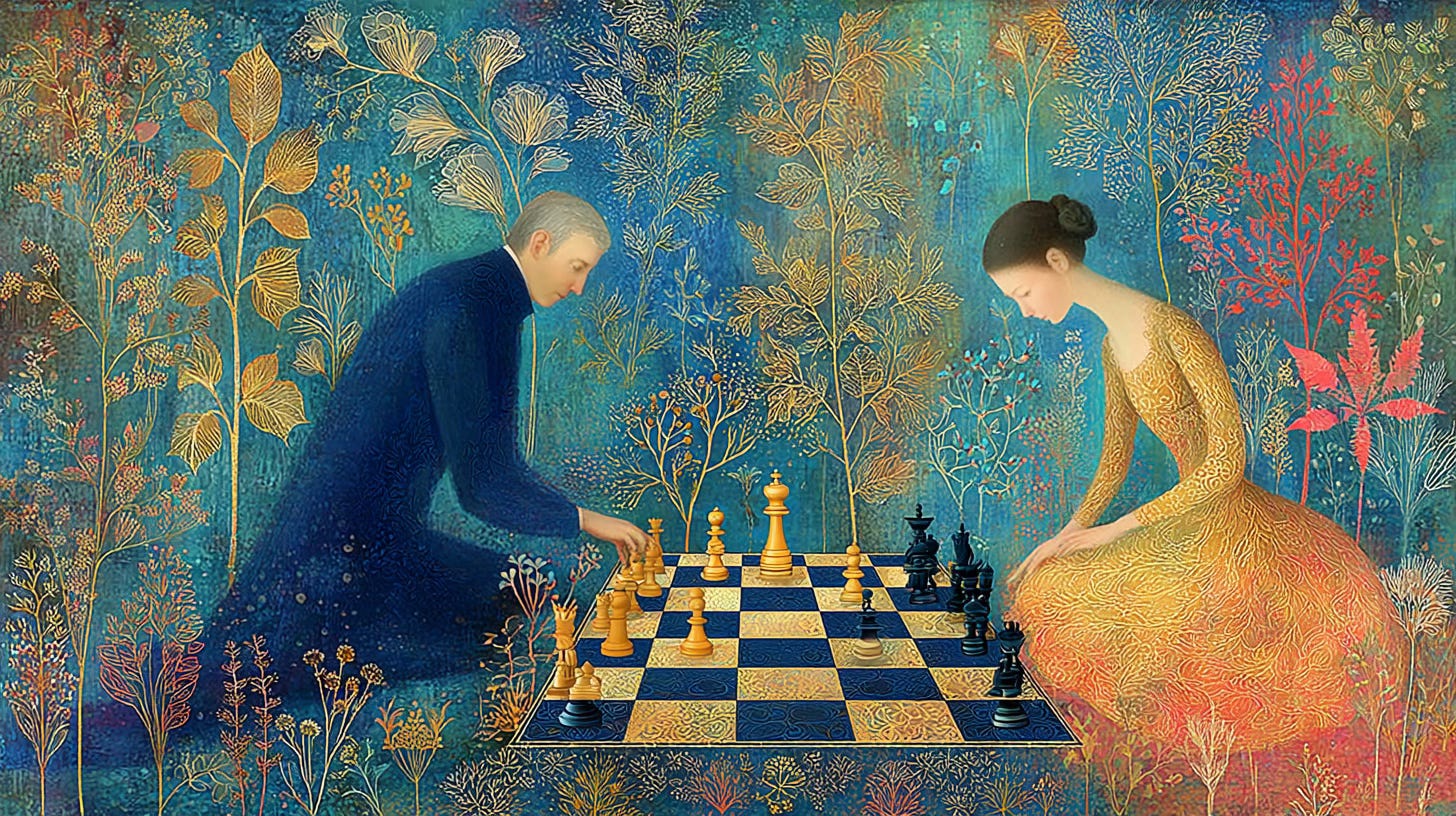
Many writers and thinkers have used chess as a metaphysical metaphor. From Hesse to Duchamp to Nabokov to Carroll, chess has inspired analogy. Chess is many things – entertainment, training, magic spell, and tool. It is a helpful metaphor for SpaceTime dimensions and reality in general.
The opposition of black and white symbolizes duality. It suggests the Spiritual war between good and evil or Truth and delusion. The chessboard's 64 squares mirror the multifaceted nature of existence. Each square represents a point where different dimensions intersect. The number 64 is a perfect cube and can be expressed as the cube of a whole number: 4^3 = 64. In Western musical notation, there are 64 eighth notes in a 4/4 time signature. In Indian classical music, there are 64 melakarta ragas. And, we mustn't forget the Beatle's song, 'When I'm 64'. I'm being tongue-in-cheek here as I have no idea of the song's significance!
There also seems to be a strong astral component to chess. When we play a game, we move energy around on the astral. The act of playing chess may also send ripples across many Timelines. We are casting spells.
The chess pieces may also be seen to represent us as individuals and our role in society. The bishops, knights and castles are authority figures of the Matrix. They support the power structures of the King and Queen. We are in perpetual Timeline Wars, and most of us are pawns. The pawn is often seen as dispensable. It is also frequently underestimated. Some pawns will reach the other side and become Queens. Some are instrumental in capturing the opponent's King.
All chess pieces are capable of absorbing the energy of other pieces. They are also capable of being absorbed. This may be a metaphor for the energetic feeding which occurs within and across many realms.
This is how I see each chess piece as it relates to the dimensions of SpaceTime:
The Pawn
The pawn, humble and steadfast, mirrors the potential for growth and evolution. This piece can only move forward in horizontal (linear) time in small jumps. That is unless it is taking a piece, in which case it has the power to move diagonally through SpaceTime.
It can be on black or white squares, meaning it can switch allegiances. As mentioned, it is the only piece with the potential to become a Queen, so it contains hidden power.
The Knight
The knight, transcending linear movement, represents the unconventional nature of SpaceTime. This piece jumps horizontally and vertically through SpaceTime in a L shape. It can move to black or white squares. Consider the L-shaped movement of magic carpets.
The Bishop
The bishop reflects the connection between seemingly distant aspects of reality. He may be the embodiment of 'spooky action at a distance'. He can only move diagonally through SpaceTime but can make vast movements. He can only stay on his own color, meaning he can never change allegiance.
The Rook/Castle
Rooks, with their orthogonal trajectory, offer structure amidst the fluidity. This piece can only jump horizontally or vertically. However, he can make enormously long jumps. He can also step beyond the confines of his color.
The Queen
The queen embodies versatility. She can move horizontally, vertically, and diagonally in all directions. She can make large and short jumps.
There is no square, black or white, which is off bounds to her. She is the Master of SpaceTime. But, in some ways, she can also be the most vulnerable piece as she has such a capacity to be out on her own.
The King
The King may be a metaphor for Consciousness. He is the 'I' or the pineal. He can only make very short jumps but in all directions. He is the center of the entire game; without him, all is lost. There is no game without him.
If this piece resonated, my book, A Map of Secret Rivers: How to Navigate Timelines, covers many of these ideas as a lived practice.
If you are ready for deep transformation, I offer one-on-one Timeline Navigation Coaching.
LaPlace's Demon and the Determinism Trap

In 1814, Pierre-Simon Laplace wrote something that has haunted philosophy ever since.
I really enjoyed this metaphor comparison. Thanks Pippa!
Thank you! I will share your insight with my son as we play together.